
According to Bizzabo, the average event campaign converts only 21.5 percent of page visitors into actual registrations. That means nearly 79 percent of interested people disappear before they ever reserve a seat. For event organizers, this is not a small gap. It is the silent difference between a buzzing venue and rows of empty chairs.
What makes this more frustrating is that most low-attendance events are not poorly planned events. Many have strong speakers, useful networking opportunities, attractive venues, and real business value. The problem usually starts much earlier, inside the digital promotion strategy, where small mistakes slowly push people away instead of pulling them in.
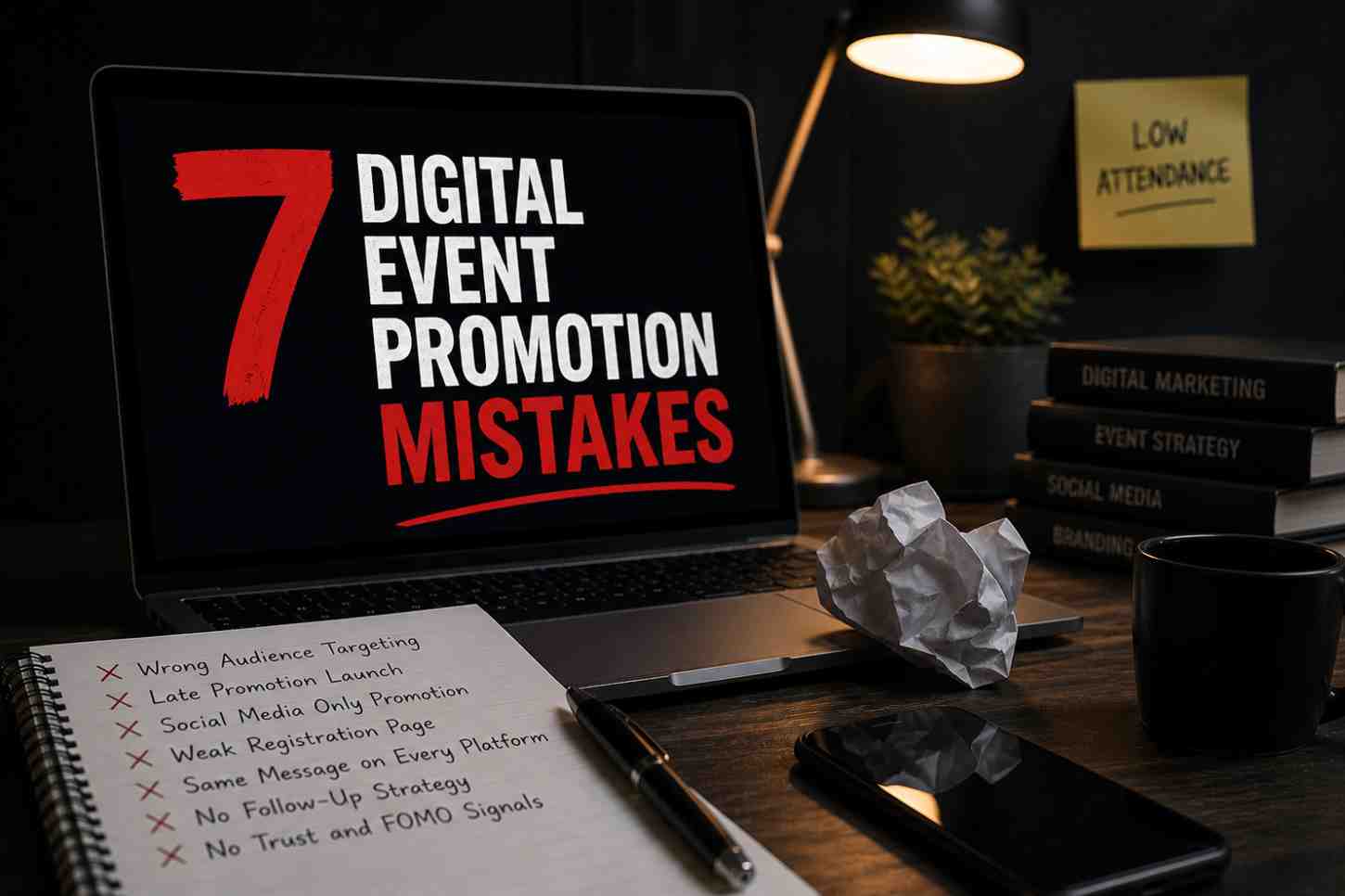
Today’s audience is surrounded by endless invites, ads, webinars, conferences, and expos every single week. Even industries that once depended mainly on offline contacts now need highly targeted online visibility to bring the right crowd to the venue. When digital promotion misses the mark, attendance starts dying long before the event date arrives. Here are the 7 digital event promotion mistakes you should know before the event date.
1. Promoting to Everyone Instead of Promoting to the Right People
This is the first and biggest mistake because it damages everything that follows. Many event organizers believe that a wider reach automatically means higher attendance. So they create broad Facebook campaigns, generic Instagram posters, bulk email blasts, and open audience ads, hoping that more eyeballs will translate into more registrations.
But broad reach is not the same as relevant reach.
Imagine you are promoting a business expo. Your ideal visitors may include distributors, suppliers, startup owners, B2B buyers, investors, or industry consultants. Now, if your ad copy simply says, “Join the biggest business event of the year,” it sounds too general.
None of those groups feels specifically called out. Everyone sees it, but nobody feels personally spoken to. Digital marketing works on relevance. People respond when they feel, “This event is for me.”
That means every event campaign should start with audience segmentation:
● Who is the primary attendee?
● What problem are they trying to solve?
● Why should they spend one day at your event?
● What exact benefit will they get?
A sponsor looks for networking visibility.
A startup founder looks for investors.
A buyer looks for supplier options.
A student looks for learning opportunities.
If all of them receive the same promotion, the message becomes weak.
Why does this kill attendance?
Because the campaign generates views without an emotional connection. You may get clicks, likes, and shares, but registrations stay low because the audience does not feel urgency.
What smart organizers do?
They create audience-specific messaging:
● one message for exhibitors
● one for attendees
● one for sponsors
● one for business visitors
This simple adjustment increases ad efficiency dramatically because every person sees a reason that feels personal. You can also plan your event from the backyard of your home, or your steel garage.
2. Starting Digital Promotion Too Late
Another deadly mistake is waiting too long to begin promotion. A lot of event teams spend months planning logistics and then suddenly realize the event is only three weeks away. That is when they start pushing heavy social media ads, email campaigns, and paid promotions. By then, the event is already behind.
People do not register just because they saw one attractive post.
Attendance grows in stages:
1. People first become aware that the event exists.
2. Then they begin noticing repeated mentions.
3. Then they evaluate if it sounds useful.
4. Then they compare with the schedule and budget.
5. Then they finally decide to register.
This decision journey takes time.
If your promotion begins too late, you are forcing cold audiences to make a fast commitment. Most people will not.
According to event marketing benchmarks published by Eventbrite, repeated pre-event engagement significantly improves registration completion because familiarity builds trust before purchase. People are much more likely to attend an event they have seen multiple times over several weeks.
Common late-promotion symptoms
● sudden ad budget spikes near event date
● desperate “limited seats” messaging too early
● low email open rates
● rushed influencer collaborations
● poor registration momentum
Best timing rule
Strong event campaigns should begin 8 to 12 weeks before the event.
The first month builds awareness.
The second month builds trust.
The final weeks push urgency.
Without this layered buildup, attendance usually stays unstable.
3. Depending Only on Social Media Posters
This mistake is extremely common because social posting feels like visible work. The design team makes daily event posters. Marketing team posts countdown creatives. Stories are uploaded. Hashtags are added.
Everyone feels a promotion is happening. But in reality, social media posters alone rarely produce enough registrations.
Why?
Because organic social media has a limited reach. Platforms do not show every post to every follower. In fact, social media algorithms prioritize entertainment and engagement, not event registration posts. A person may follow your page and still never see most of your updates.
Also, not every interested attendee converts from a casual scroll. Many people need repeated reminders in different formats before taking action.
This is why successful event promotion is multi-channel:
● social media awareness
● email nurturing
● WhatsApp reminders
● retargeting ads
● partner collaborations
● event listing websites
● speaker promotion clips
● sponsor audience cross-promotion
If one channel underperforms, the others keep the campaign alive.
Why social-only promotion fails?
Because it creates visibility without a follow-up funnel. Someone may like your poster today and forget it tomorrow.
But if they later receive:
● an email invitation,
● then a testimonial clip,
● then a reminder ad,
The registration chance becomes much higher. This repeated contact creates memory and trust.
4. Sending Interested Visitors to a Weak Registration Page
Let us say your ads are running well. People are clicking. Traffic is coming. Now comes the painful part. Many organizers lose all that traffic on a badly designed registration page.
This is where attendance silently collapses.
A visitor lands on the page and sees:
● too much text
● unclear event agenda
● no speaker highlights
● no benefit summary
● long form fields
● slow mobile loading
● no urgency
Within seconds, they leave.
Remember, online visitors are impatient. They do not want to investigate whether your event is worth attending. They want the page to convince them quickly.
A good event landing page should answer five questions almost instantly:
1. What is this event?
2. Who is it for?
3. Why should I attend?
4. What will I gain?
5. How easy is it to register?
If these answers are buried in paragraphs or scattered visuals, conversion drops. Here is a simple comparison:
| Weak Registration Page Problem | What Visitor Feels | Result |
| Too much generic text | Confused | Leaves page |
| Long registration form | Feels like effort | Postpones |
| No social proof | Unsure if the event is credible | Hesitates |
| Poor mobile design | Annoyed | Exits |
| Weak CTA | No urgency | No sign-up |
This one mistake alone can waste a huge ad budget because the campaign may generate traffic, but the page fails to convert it.
5. Using the Same Promotional Message on Every Platform
Many organizers create one promotional caption and copy-paste it everywhere: Facebook, Instagram, LinkedIn, Email, WhatsApp, Telegram. This looks efficient, but it weakens engagement. Different platforms have different user psychology.
A LinkedIn user is in a professional mindset. They care about networking, business growth, and industry relevance. An Instagram user is attracted by visuals, excitement, speaker energy, and event atmosphere. An email reader wants detailed reassurance and practical value. A WhatsApp user responds better to short, urgency-driven reminders.
When all these channels receive the same sentence, the message loses persuasive strength.
Example:
Same generic line: “Register now for our upcoming annual business summit.” This sounds flat everywhere.
Now compare platform-specific messaging:
LinkedIn:
Meet 100+ business leaders and decision-makers in one place.
Instagram:
See the speakers, the crowd, the energy. This is where ideas turn into deals.
Email:
Why professionals are reserving seats early for this year’s summit.
WhatsApp:
Seats filling fast. Confirm your registration today.
Same event. Different emotional hooks.
Why this matters:
Because repetition without variation causes audience blindness. People keep seeing your campaign but stop noticing it. Fresh framing keeps the event feeling active and important.
6. Ignoring Follow-Up After the First Click
This is where most event campaigns lose warm leads. A visitor clicks your ad, checks the page, gets distracted, and then leaves.
An email subscriber opens the invite. Reads half of it, plans to register later, forgets. A person watches your speaker teaser, feels interested, and does nothing immediately.
All these people are not lost yet. They are warm prospects. But if there is no follow-up system, they become lost. Modern conversion behavior is not single-touch. People need reminders.
According to recent event campaign data from Bizzabo, high-performing event marketers increasingly rely on multi-touch attendee nurturing because repeated contact improves registration consistency across channels.
This means one invitation is not enough.
You need:
● reminder emails
● abandoned registration nudges
● retargeting social ads
● countdown messages
● speaker reveal updates
● limited seat urgency notifications
Each follow-up acts like a small push. Without these pushes, interested visitors simply disappear into digital noise.
Simple 3-step follow-up formula:
1. First reminder: You showed interest. Here is what you will gain.
2. Second reminder: Here is proof that others are joining.
3. Final reminder: Registration closes soon.
This sequence recovers a surprising amount of lost sign-ups.
7. Failing to Build Trust and FOMO
People do not attend events only because they understand the agenda. They attend because they believe the event is worth their time. That belief comes from trust signals and FOMO.
If your promotion only says: Date, Venue, Timing, Ticket Link
Then it feels like a plain announcement. There is no emotional energy. Now compare that with promotions showing:
● keynote speaker videos
● sponsor logos
● previous crowd photos
● attendee testimonials
● “500+ registrations confirmed.”
● behind-the-scenes prep clips
● networking opportunity highlights
Suddenly, the event feels alive. This creates two psychological effects:
Trust:
People think: this looks legitimate, active, and professionally supported. FOMO:
People think: others are joining, I should not miss this.
Humans are social decision-makers. We feel safer attending something that already looks validated by others. That is why events with visible momentum keep gaining registrations faster near the deadline. Without trust and FOMO, your event remains just another invitation in a crowded inbox.
Quick Snapshot: How These Mistakes Quietly Reduce Attendance
| Mistake | What It Causes | Final Attendance Damage |
| Wrong audience targeting | Low relevance | Poor registrations |
| Late campaign launch | Low awareness time | Weak turnout |
| Social media only | Limited repeated exposure | Missed visitors |
| Weak landing page | Visitor drop-off | Lost sign-ups |
| Same message everywhere | Low engagement | Ad blindness |
| No follow-up | Warm leads fade away | Lower conversions |
| No trust or FOMO | Low urgency | Last-minute hesitation |
Before You Leave:
Digital event promotion is not about posting more flyers online and hoping people register. It is about building a complete path that carefully moves a stranger from attention to trust, from trust to interest, and from interest to commitment.
Most attendance failures do not happen on event day. They happen quietly during the weeks before the event when campaigns target the wrong people, start too late, use weak landing pages, repeat boring messaging, and forget to nurture warm leads.
The good part is this: these are fixable mistakes.
When organizers understand where audience interest leaks, they can plug those gaps early. Better segmentation, earlier promotion, multi-channel visibility, stronger follow-up, and social proof can dramatically improve turnout.
A successful event does not start when the gates open. It starts when the digital campaign begins.