
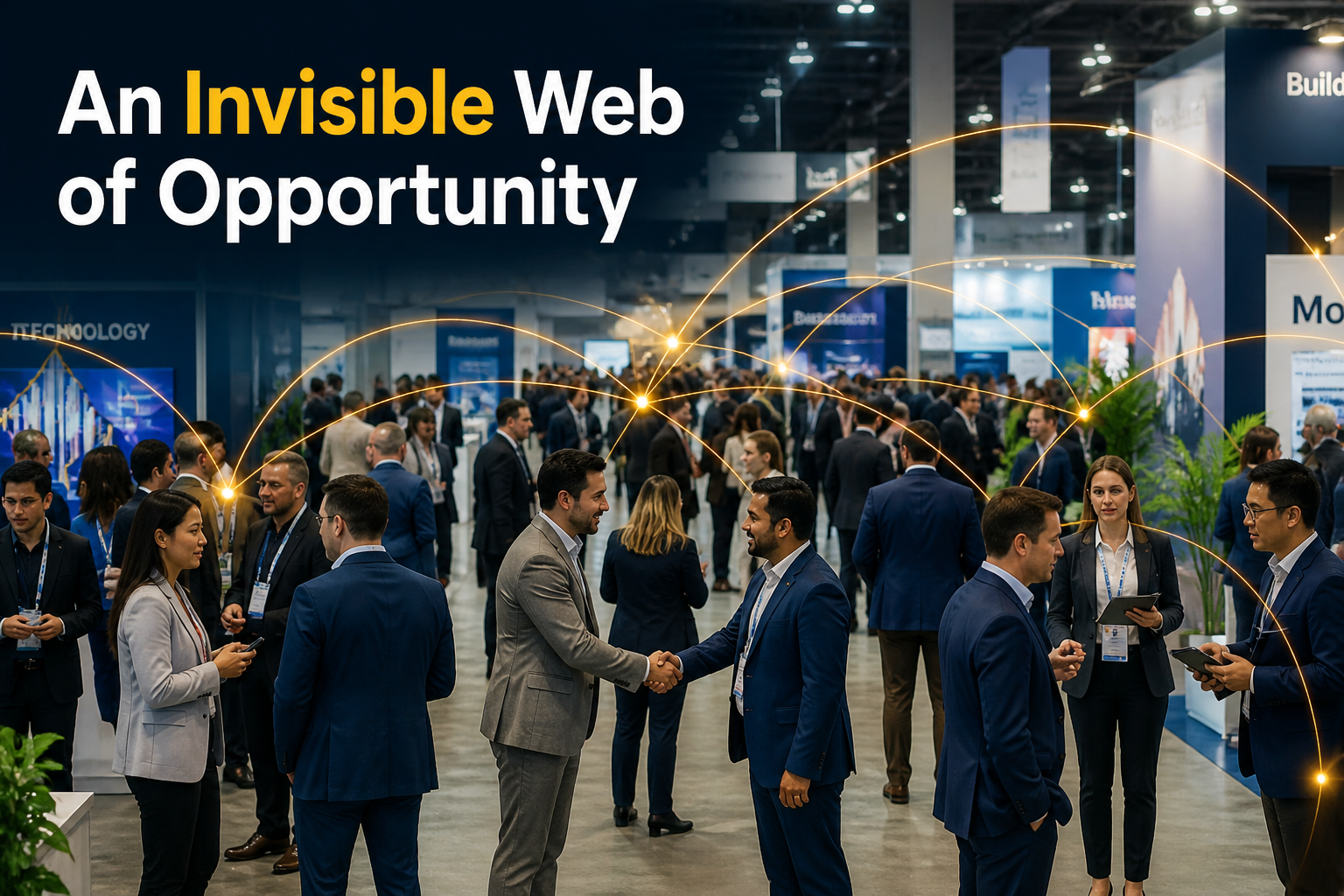
Think about the last time you landed a great business opportunity. Was it from a cold email? A paid ad? Or was it from a conversation with someone you met at an event? For most professionals, the honest answer points to people, not platforms. Business events have always had a reputation for being expensive, time-consuming, and hard to measure. But something has shifted. Quietly, steadily, they have become one of the most effective tools for building real business connections in a world drowning in digital noise.
The Comeback Nobody Announced
Business events are not just back. They are bigger, more intentional, and more valuable than ever before. The number of events worldwide grew by a remarkable 52% in 2024 compared to 2023 (Meetings Today). That is not a blip. That is a signal that professionals everywhere are rediscovering something that apps and automation simply cannot replicate: the power of being in the same room.
For years, the narrative was that digital would replace in-person gatherings. It did not. Instead, going through a period of virtual-only meetings made people appreciate face-to-face interaction even more. A 2025 Meetings Today survey found that 59% of event professionals are seeing higher attendance at networking events now than before the pandemic. People are showing up, and they are showing up with purpose.
Why the Format Still Matters
The format of an event shapes the quality of connection you walk away with. Conferences, trade expos, business summits, and workshops each serve a unique role in your networking strategy. A Harvard Business Review-cited survey found that 95% of professionals believe face-to-face meetings are essential for building long-term business relationships.
No video call or LinkedIn message can fully replicate the trust built when two people share physical space. Even industries that seem worlds apart from events recognize this. Think about how companies across sectors, whether they sell software, construction services, or even infrastructure like commercial metal garages, rely on trade shows and industry expos to forge supplier relationships and close bulk deals. The principles of face-to-face trust are universal.
What makes the format matter is context. When you are at a business event, every person in the room has self-selected. They chose to be there, which means they are already open to conversation, collaboration, and opportunity. That shared context collapses the barrier between stranger and prospect faster than any cold outreach ever could.
What Makes These Events Quite Goldmines
The word ‘goldmine’ gets thrown around loosely, but the data behind business events earns it. According to the Splash Events Outlook Report 2025, 52% of marketers attribute at least half of their company’s closed deals directly to events. That is not a supporting channel. That is a primary revenue driver hiding in plain sight. If you have been treating events as a soft branding exercise, you may be leaving your best leads on the table.
● You Are Already in a Room Full of Decision-Makers
One of the most underrated advantages of attending corporate networking events is the density of decision-making power in one room. At a well-curated business conference or industry summit, you are not navigating gatekeepers or waiting for email replies. You are standing next to the exact person who signs off on budgets, approves vendor relationships, or greenlights partnerships. Access like that is genuinely rare in everyday business life, and events hand it to you on a plate. The key is knowing how to use it without coming across as transactional.
● Warm Leads, Not Cold Calls
Cold outreach has a notoriously low conversion rate. But a conversation at a networking mixer or panel discussion pre-warms a lead in a way that no email sequence can. When someone has spoken to you, laughed with you, or heard your point of view on a shared industry challenge, they carry a mental picture of you long after the event ends. 70% of professionals globally say they were hired or brought into opportunities at companies where they already knew someone (Wave Connect, 2025). That personal familiarity is the currency that business events manufacture at scale.
Business Events: Key Networking & Growth Statistics
| Metric | Figure | Source |
| Professionals who believe face-to-face meetings are essential for long-term business relationships | 95% | Harvard Business Review |
| Marketers who say in-person events generate the most revenue | 66% | Splash Events Report 2025 |
| Marketers who say events are critical for business growth | 89% | Splash Events Report 2025 |
| Professionals hired through someone they already knew | 70% | Wave Connect 2025 |
| Event professionals reporting higher attendance than pre-pandemic Increase in the number of events in 2024 vs 2023 | 59% 52% | Meetings Today 2025 Meetings Today |
How to Turn Attendance into an Actual Opportunity
Showing up is only step one. The professionals who consistently generate business from corporate events treat attendance as a strategy, not just a schedule item. There are three clear windows where networking value is created, and most people only use one of them.
● Before the Event: Set Your Networking Goals
Most people walk into business events without a plan, which is why most people walk out without results. Before you arrive, spend 20 minutes identifying two or three specific types of contacts you want to make. Review the attendee list if it is available. Research speakers or exhibitors who are relevant to your work or growth goals. When you enter the room with a target in mind, every conversation has a direction, and you are far less likely to spend your time in comfortable but unproductive small talk with people you already know.
● During the Event: Be Intentional, Not Just Present
The difference between a networker and a connector is intention. During the event, lead with curiosity rather than your elevator pitch. Ask what challenges someone is working through, what brought them to this event, or what they are excited about in their industry. People remember how you made them feel far longer than what you said. Attending workshops and breakout sessions within the event also tends to generate higher-quality connections because the smaller format allows for real dialogue rather than surface-level introductions. According to Freeman’s 2024 Attendee Intent Survey, 52% of attendees specifically seek out events where they can discuss industry challenges with peers.
● After the Event: The Follow-Up is Where the Magic Happens
Here is where most of the value either gets captured or evaporates. Within 48 hours of the event, send a short, personalised message to every meaningful contact you made. Reference something specific from your conversation so they know it is not a mass email. Suggest a next step, whether that is a brief call, sharing a resource, or simply connecting on LinkedIn. The follow-up is not a formality. It is the bridge between a pleasant conversation and an actual business relationship. Most people skip it, which means doing it puts you ahead of the crowd instantly.
Types of Business Events Worth Your Time
Not every event delivers the same networking value. The type of event you choose should align with your specific goal, whether that is generating warm leads, finding strategic partners, or building visibility in your industry. Here is a quick reference to help you decide where to invest your time.
Business Event Types and Their Networking Value:
| Event Type | Best For | Networking Value |
| Industry Conferences | Meeting sector leaders & peers | Very High |
| Trade Shows & Expos | Lead generation & product demos | High |
| Business Summits | C-suite & decision-maker access | Very High |
| Workshops & Seminars | Skill-sharing & peer bonding | Medium-High |
| Networking Mixers | Casual introductions & warm leads | High |
| Hybrid Corporate Events | Wider reach with live depth | High |
Common Mistakes That Leave Networking Value on the Table
Even seasoned professionals make networking mistakes that quietly cost them. Knowing what to avoid is just as important as knowing what to do. Watch out for these patterns the next time you attend a business event for professional networking.
• Collecting business cards without context. A stack of cards means nothing if you cannot remember the conversation. Jot a quick note on the back immediately. • Spending the whole event with your existing team. Events are not team outings. Split up and cover more ground.
• Pitching too early. Networking events are not sales floors. Build rapport first. The pitch comes later, if at all.
• Skipping the post-event follow-up. A warm lead gone cold is harder to revive than starting fresh. Follow up within 48 hours, every time.
• Attending without a goal. Random attendance produces random results. Know what you are there to achieve.
Long Story Short:
Business events are not just back. They are smarter, more targeted, and more valuable as a lead generation and relationship-building tool than they have ever been. In a world where your inbox is a battleground and social media reach is shrinking, being physically present in a room full of the right people is still one of the most powerful moves you can make. 89% of marketers say events are critical for business growth (Splash 2025). The question is no longer whether to attend. It is whether you have a strategy to make the most of it.
Start small if you need to. Pick one industry event in the next 90 days. Go in with a goal. Follow up within 48 hours. Then see what happens.