
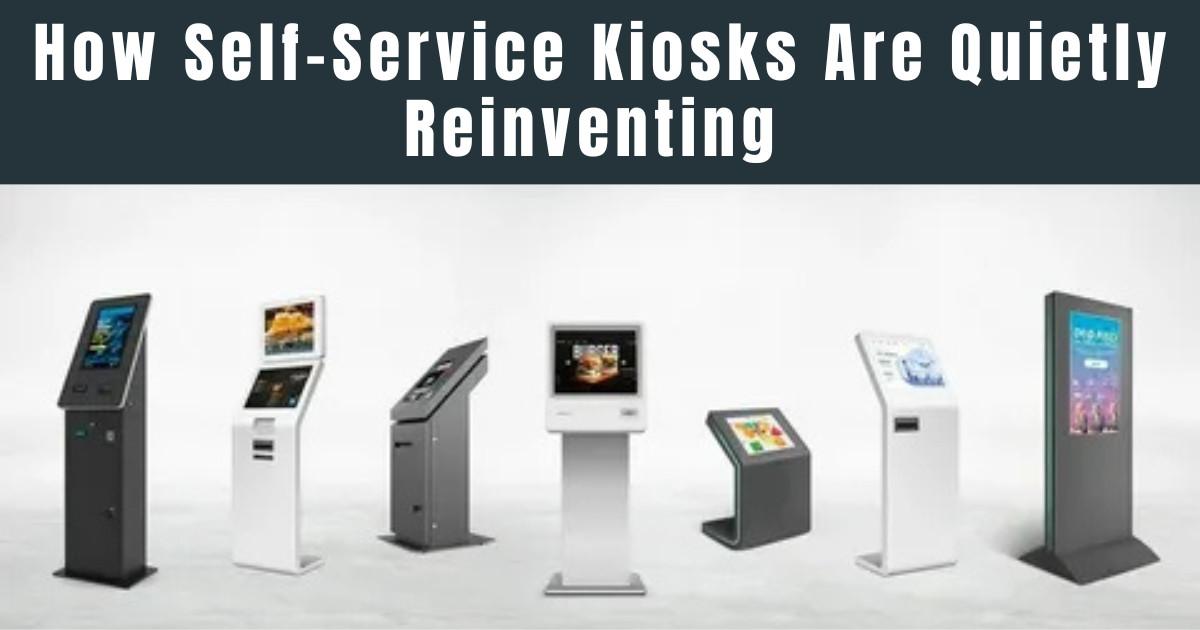
Long queues and standing in line have been an inherent part of people’s daily lives for ages. Queuing at a bank, government office, or airport has been the most frequent scenario in which people have encountered delays and thus encountered services with the least in-demand quality, i.e., patience. Nevertheless, a technological revolution is slowly but surely changing the way people experience waiting in long lines.
The arrival of self-service kiosks, or ultra-modern, user-friendly terminals, is almost everywhere (in shopping malls, airports, hospitals, local government centres, etc.) and is transforming the traditional waiting time VS convenience equation. Without seeking much attention, they are bringing about a revolution in the way billions of people interact with different services daily.
A Quiet Revolution: What Are Self-Service Kiosks?
Essentially defined, a self-service kiosk is a digital terminal which users operate to carry out transactions or get services by themselves, i.e. without the intervention of the staff. The first version traces back to the automated teller machines (ATMs), which changed retail banking radically; in fact, they empowered customers to get money any time they wanted. Later, airline check-in kiosks upgraded the travel procedures by making them more efficient.
At the moment, the concept has taken over a vast number of different sectors and is no longer limited to banking but can be found in retail stores and quick-service restaurants (QSRs) as well as in hospitals, railway stations, and even government offices. The kiosks turn out to be very strong due to their feature of combining the access, the speed, and the independence all in one single small interface. In industries where paperwork and slow manual processes have been the order of the day, kiosks are the ones that provide the solution quietly.
Beyond Retail: Everyday Impacts Across Sectors
The use of kiosks has gone beyond shops, opening up a whole new world for kiosks in which they have entered nearly all public and private places.
Retail: In self-checkout supermarkets, technology has brought about significant improvements and the adoption of QSR kiosks is set to change the way people interact with fast food restaurants drastically by allowing them to place, customise and pay for orders without the necessity to wait at the counter. The outcome is a quicker service and more control over the purchasing experience.
Banking and Finance: In the last few decades, ATMs, passbook printing devices, and bill payment machines have become part and parcel of the round-the-clock banking access culture. Financial kiosks are the solution to staff dependency problems while enabling extended service hours.
Healthcare: Appointment scheduling, patient check-in, and hospital information kiosks reduce crowding at the reception desk. They help patients transfer to immediate cases more easily and free medical staff from facilities for urgent cases.
Public Sector & Transport: Kiosks are in use in government offices for performing activities such as filing taxes, updating official documents, or applying for welfare services. They are the means for raising both accessibility and transparency in governance. Kiosks are essential to airports and train stations which have automated ticketing, check-in, and baggage drop facilities, thus providing travellers with seamless journeys.
Streamlining Service for All Users
The move to kiosks worldwide is not a mere story but a result supported by numbers. Customer experiences and government reports validate the fact that the use of kiosks reduces waiting times by more than 30%, increases transaction speed, and raises customer satisfaction levels. Such advancements in the processes also reflect the better usage of the infrastructure.
Over 60% of governments worldwide have adopted e-Government strategies that allocate most resources to digital infrastructure and self-service tools. The country of India is an example of such a trend through its network of e-seva centres and urban kiosks serving public, utility, and financial services. A report by Pristine Market Insights is all in agreement about the speed of such an adoption, making kiosks the most preferred channel for citizens, especially in cities where the need for quick services is high.
Touchless, Fast, and Personalised: Why the Adoption Is Increasing
Before the pandemic, the kiosk adoption had a positive trend, which was boosted even more by the post-pandemic world. Contact-free transactions were the new normal, hence the fast implementation in transport hubs, restaurants, and government offices. Touchless ticketing systems or QR-enabled ordering stations are just some of the digital measures that have been put in place. The aspect of digital readiness has also been a factor.
The increasing number of smartphone users, the almost universal availability of the internet, and the growing willingness to use digital payments have all contributed to the rise of kiosks. One can get a train ticket in less than a minute, get food recommendations based on the previous orders, or even get government forms in the local language. These capabilities have turned kiosks into not only devices of ease but also of uniqueness and acceptability.
Advantages and Benefits of Kiosks
The everlasting enthusiasm for kiosks can be fully justified through their numerous advantages as follows:
- Convenience: People can get access to the services offered by kiosks at any time of the day without waiting.
- Efficiency: The usage of public infrastructure is improved because wait times and congestion are minimised to a great extent.
- Cost Savings: Businesses and governments reduce staffing requirements for routine tasks.
- Hygiene: Contactless kiosks improve public health safety, especially post-pandemic.
- Inclusivity: The addition of different languages for support and the use of accessibility interfaces in services have made it possible for more people to get the service.
- Transparency: Reliable digital transaction trails lead to higher levels of accountability and trust between people.
These are just some of the benefits that show why kiosks are the new normal when it comes to service delivery.
Kiosk Deployment Challenges
The problems that kiosks have include expensive initial costs, which limit the number of kiosks available in areas with limited resources. Apart from that, poor internet connectivity has been a major barrier to the use of kiosks in rural areas. The falling of user data into the hands of attackers is one of the main cybersecurity threats that calls for very robust privacy protection measures.
Moreover, the question of accessibility for the elderly, disabled and those with little digital knowledge is still a challenge that needs to be addressed through the development of more user-friendly, carefully designed solutions.
The Future of Self-Service Kiosks
One of the most significant markets for technology is the self-service kiosks market. These AI-powered kiosks will soon be able to offer users predictive recommendations, biometric authentication, and multilingual support. The use of IoT integration, smart city initiatives, and digital payments will be the main factors behind mass adoption. Within the next ten years, kiosks will be everywhere, revolutionising customer experiences and verifying the disappearance of traditional queues.